



Local AI Explained: How AI PCs and Mini PCs Run AI Locally in 2026
The Problem with Cloud-Only AI
Most AI experiences today depend on cloud services. Users send data to remote servers, wait for processing, and receive results over the network. This model works - but it has clear limits.
Data privacy becomes a concern when sensitive files and business information leave the device. Network latency slows down real-time interactions. Subscription costs accumulate over time. And when the internet goes down, so does every AI tool.
These limitations are pushing the industry toward a different approach: running AI directly on the user's own computer. This concept - often referred to as Local AI - represents a fundamental shift in how personal computers handle intelligent workloads.
What Is Local AI?
Local AI refers to artificial intelligence workloads that run natively on a personal device rather than on remote cloud servers. Instead of routing every request through external infrastructure, the computer's own processor handles AI inference, model execution, and data processing.

Modern hardware makes this feasible. CPUs, GPUs, and NPUs (Neural Processing Units) now provide enough computational power to run language models, generate images, and process documents without leaving the device.
For anyone researching local computer AI, the core value proposition is straightforward: faster responses, stronger data privacy, and full user control over how AI tools operate.
Local AI vs Cloud AI
| Feature | Cloud AI | Local AI |
|---|---|---|
| Processing location | Remote data centers | User's own device |
| Internet dependency | Required | Reduced |
| Data control | Managed by providers | Controlled locally |
| Response speed | Network-dependent | Faster for local tasks |
| Customization | Platform-limited | Flexible |

Cloud AI remains essential for workloads that demand massive compute - training frontier models, serving enterprise-scale APIs, and running applications that exceed local hardware capacity. Local AI complements this by handling tasks where privacy, speed, and offline availability matter most.
AI PCs: The Hardware Foundation for Local AI
Running AI locally requires more than a standard computer. AI PCs integrate dedicated acceleration hardware - typically a combination of CPU, GPU, and NPU - designed to handle machine learning inference efficiently.
This is not a niche category. According to Gartner, AI PCs are projected to account for 54.7% of all PC shipments by 2026, up from 15.6% in 2024.
| Year | AI PC Market Share | Shipments |
|---|---|---|
| 2024 | 15.6% | 38.1 million |
| 2025 | 31.0% | 77.8 million |
| 2026 | 54.7% | 143.1 million |
Source: Gartner, August 2025
Growth is strong across both laptops and desktops:
| Category | 2024 Share | 2026 Share |
|---|---|---|
| AI Laptops | 19.4% | 58.7% |
| AI Desktops | 3.8% | 42.1% |
Source: Gartner, August 2025
Within two years, most new PCs will ship with built-in AI acceleration. This hardware shift enables a range of local computer AI applications - from running personal AI assistants and generating content locally, to testing language models and automating workflows without cloud dependencies.
NVIDIA DGX Spark: Defining the Ceiling of Desktop AI
If AI PCs represent the broad market shift, NVIDIA DGX Spark represents its extreme edge - what becomes possible when serious AI compute is packaged into a desktop form factor.

Source: corsair-What is NVIDIA DGX Spark
Announced in March 2025 and built around the NVIDIA GB10 Grace Blackwell Superchip, DGX Spark is a compact AI workstation designed for developers, researchers, and engineers who need to run, test, and iterate on large AI models locally.
Hardware Specifications
| Specification | Details |
|---|---|
| AI Platform | NVIDIA GB10 Grace Blackwell Superchip |
| GPU Architecture | NVIDIA Blackwell |
| AI Performance | Up to 1 PFLOP (FP4, with sparsity) |
| CPU | 10x Cortex-X925 + 10x Cortex-A725 (ARM) |
| Memory | 128GB LPDDR5x, unified |
| Memory Bandwidth | 273 GB/s |
| Storage | Up to 4TB NVMe SSD |
| Networking | 10GbE + 200GbE ConnectX-7 |
| Wireless | WiFi 7, Bluetooth 5.4 |
| Display | HDMI 2.1a, up to 3x DisplayPort over USB-C |
| Dimensions | 150 x 150 x 50.5 mm |
| Weight | 1.2 kg |
| Power Supply | 240W (GB10 TDP: 140W) |
| OS | NVIDIA DGX OS |
| AI Model Support | Up to 200B parameters (quantized) |
Source: NVIDIA DGX Spark official specifications
Two units connected via 200GbE can handle models up to 405 billion parameters.
What DGX Spark Actually Enables
The specifications matter because of what they unlock in practice:
Large model inference locally. Running a 70-billion-parameter language model on a single desktop device was not realistic two years ago. DGX Spark's 128GB unified memory and 1 PFLOP of FP4 throughput make it feasible - no cloud subscription, no data leaving the device.
Rapid AI development cycles. Developers can fine-tune, test, and debug AI models on-site without waiting for cloud GPU availability. For teams iterating on agentic AI workflows or custom model architectures, this compresses development timelines significantly.
Edge deployment prototyping. Organizations building AI for retail, manufacturing, or healthcare environments can prototype and validate edge AI applications on DGX Spark before deploying to production infrastructure.
Recommended Video: NVIDIA DGX Spark Introduction
NVIDIA DGX Spark - Your Own Personal AI Supercomputer
Source: NVIDIA Developer on YouTube
The Gap DGX Spark Leaves Open
DGX Spark proves that data-center-class AI can fit on a desk. But it is priced and positioned for professional AI workloads - not for the user who wants AI-assisted writing, local document processing, or a smarter desktop experience.
This creates a clear gap in the AI PC ecosystem: who brings local computer AI to everyday users?
AI Mini PCs: Local AI for the Rest of Us
If DGX Spark defines the performance ceiling, AI Mini PCs define the accessibility floor.
The majority of users do not need to run 200-billion-parameter models. They need a compact, efficient computer that can handle daily productivity, support AI-assisted workflows, and run smaller local models - at a price point and form factor that fits a home office or small business.
AI Mini PCs bridge this gap by combining modern processors with AI acceleration hardware in a small desktop design. Where traditional Mini PCs focused on basic computing tasks - office work, media playback, digital signage - the latest generation adds NPU-enabled processors, stronger graphics, and sufficient memory to handle local computer AI workloads.
This evolution changes what a compact computer can do. An AI Mini PC can assist with writing and research, process images and video locally, run lightweight language models, and automate tasks - all without sending data to external servers.

ACEMAGIC and the Compact AI PC Category
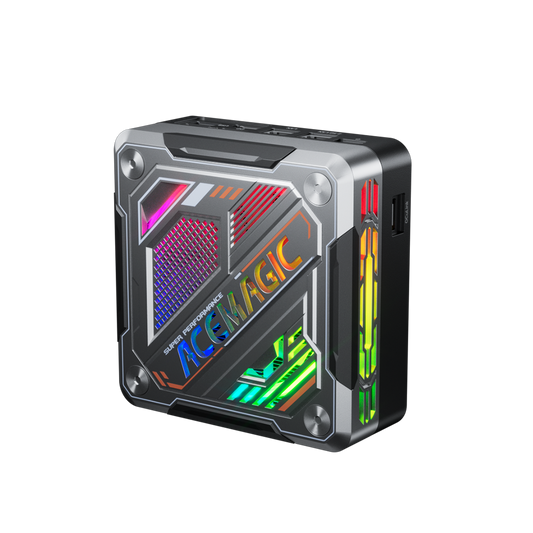
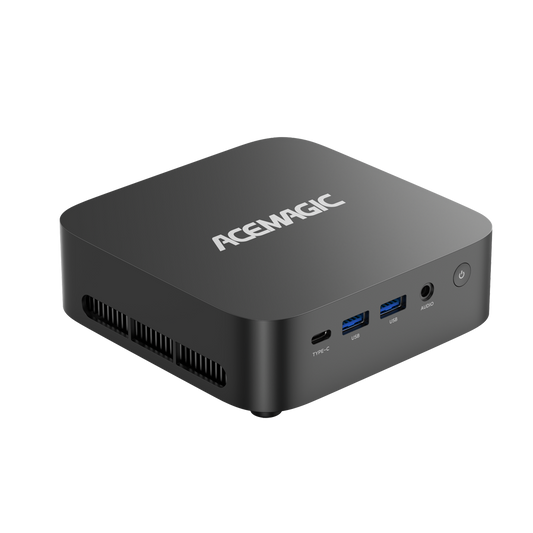
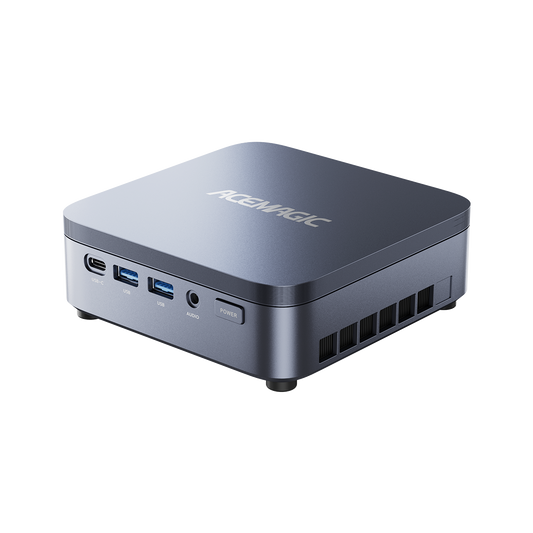
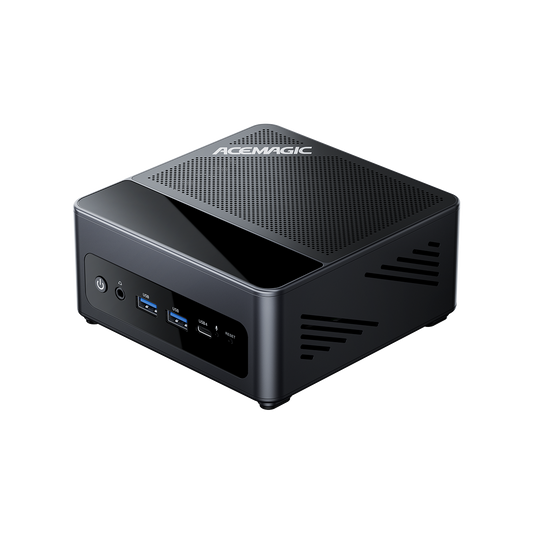
ACEMAGIC builds compact computing solutions designed for exactly this use case: capable hardware in a small form factor, optimized for users who want more than a basic desktop but do not require a professional AI workstation.
As AI PC hardware becomes standard across the industry, Mini PCs are positioned to become one of the most practical ways for everyday users to access Local AI. They offer the efficiency and size advantages that have always defined the category, now paired with the AI capabilities that modern computing demands.
The Local AI ecosystem spans a wide spectrum:
| Device Type | Target User | AI Capability |
|---|---|---|
| AI Workstation (e.g., DGX Spark) | Researchers, AI developers | Large model inference, full AI development |
| AI Desktop | Professionals, creators | High-performance AI-assisted workflows |
| AI Laptop | Mobile users | Portable AI productivity |
| AI Mini PC | Everyday users, home offices | Compact local AI, daily AI-assisted tasks |
Each tier serves a different need. Together, they form a complete ecosystem where local computer AI is available at every price point and performance level.
Frequently Asked Questions
What is Local AI?
Local AI means running AI models and applications directly on your own computer instead of relying on cloud servers. It provides faster responses, stronger data privacy, and offline availability.
Do I need a special computer for Local AI?
Basic AI tasks can run on standard hardware. For more demanding workloads - running language models, generating images, or processing large datasets - an AI PC with dedicated NPU or GPU acceleration delivers a significantly better experience.
What is NVIDIA DGX Spark?
NVIDIA DGX Spark is a compact AI workstation built on the NVIDIA GB10 Grace Blackwell Superchip. It provides 1 PFLOP of AI performance and 128GB unified memory, designed for developers and researchers running large AI models locally.
How much does an AI PC cost?
Entry-level AI Mini PCs start around $300-$500. Mid-range AI PCs (laptops and desktops) range from $800-$1,500. Professional systems like DGX Spark are priced at approximately $3,000 or above.
Can a Mini PC run Local AI?
Yes. Modern AI Mini PCs with NPU-enabled processors and sufficient memory can handle AI-assisted productivity, content creation, and smaller local models. They offer a practical balance of performance, size, and cost for everyday users.
DGX Spark vs AI Mini PC - which do I need?
Choose DGX Spark if you develop or research AI professionally and need to run large models locally. Choose an AI Mini PC if you want a compact, affordable computer for daily tasks with AI-assisted features. Most users fall into the second category.
What can you do with Local AI on a Mini PC?
Common use cases include AI-assisted writing and research, local document processing, image editing, workflow automation, and running lightweight language models - all without uploading data to external servers.
Conclusion: Local AI Is Reshaping Personal Computing
The shift from cloud-only AI to local AI is not a future prediction - it is already happening. AI PCs are becoming the majority of new computer shipments. Hardware that once required server rooms now fits on a desktop.
NVIDIA DGX Spark has shown what is possible at the top end: data-center-class AI performance in a compact device. AI Mini PCs are making the same local computer AI paradigm accessible to everyday users - at lower cost, smaller size, and with lower power consumption.
The next generation of personal computing will not be defined by clock speeds or storage capacity. It will be defined by how well a computer can understand, assist, and adapt to its user - locally, privately, and on demand.
References
- Gartner. (2025, August). Gartner Says Artificial Intelligence PCs Will Represent 31 Percent of Worldwide PC Market by the End of 2025. Gartner Newsroom. https://www.gartner.com/en/newsroom/press-releases/2025-08-28-gartner-says-artificial-intelligence-pcs-will-represent-31-percent-of-worldwide-pc-market-by-the-end-of-2025
- NVIDIA. (2025). NVIDIA DGX Spark Hardware Overview. NVIDIA Documentation. https://docs.nvidia.com/dgx/dgx-spark/hardware.html
- Corsair. (2025). What Is NVIDIA DGX Spark?. Corsair Explorer. https://www.corsair.com/us/en/explorer/gamer/gaming-pcs/what-is-nvidia-dgx-spark/
- NVIDIA Developer. (2025). NVIDIA DGX Spark - Your Own Personal AI Supercomputer [Video]. YouTube. https://www.youtube.com/watch?v=owD8jmnM_ng